Hilltackler’s top 5 backpacking trips in New York

The highest mountain in New York may only be 5, 2144’ but it is home to thousands of miles of historically rich hiking trails through diverse forests and ecosystems. 

Some trails date back to the Revolutionary War when soldiers blazed a path in upstate New York, through what is now known as Harriman State Park. 

 In the 1820’s famous artists such as Thomas Cole were inspired to paint the peaks of Catskills. And finally, New York State is home to the Adirondacks, the country’s largest park and state protected land area in the contiguous United States, with 6.1 million acres of land. What New York lacks in vertical elevation it makes up for in unsurpassed beauty. All within a day’s drive from New York City the country’s largest with a population of 8.41 million people. 

 Despite our wildernesses close proximity to such a large metropolitan area, the trails still offer plenty of solitude. I’ve put together a list of my 5 favorite backpacking trips. 


#5 The Blackhead Range, Catskills New York:
A fairly short but moderately strenuous two day backpack of approximately 17 miles in the northern Catskills, including four peaks over 3500 feet and lovely scenery from the northern ridge of the Escarpment Trail. Day one of this trip starts at the northern terminus of the Escarpment Trail just outside of East Windham, NY. The rocky path winds its way up through a Norwegian Pine forest and up the first of four Catskill high peaks, Windham Mountain (3524’). The descent down Windham offers some great views from Burnt Knob and Acra Point. Dropping down from the Escarpment Trail to the Batavia Kill Trail a lean-to/tent sites and water source makes for a nice place to rest up for the next day’s adventure. The second day starts out with a climb of 1,000 feet in nine tenths of a mile to the top of Blackhead Mountain (3940’) the fourth highest peak in the Catskills. After descending Blackhead Mountain Trail the hike now picks up the Black Dome Trail to go up and over Black Dome (3980’) as well as Thomas Cole Mountain (3940’). The final descent off the ridge line offer views of the valley and surrounding mountain ranges. 

# 4 Pharaoh Lakes Wilderness Area, Eastern Adirondacks, NY: This area of the Adirondacks is a backpacker’s paradise, with its many lakes, ponds and miles of trails providing the opportunity for trips in a variety of lengths. This particular 3 day/2night backpacking trip will reach only one peak above 2000’ but the views of the many pristine lakes and ponds will more than make up for the lack of elevation. Day 1 follows the fairly easy terrain as it meanders through the heavily covered forest. After 2 miles the trail gets steeper and rockier until it reaches the top of Pharaoh Mountain (2551’). There are terrific views of the High Peaks in the distance from the rock ledges of the summit on the west side. The trail descends steeply at times and gives way to the beautiful shore line of Pharaoh Lake. There are six lean- to’s along the lake but my preferred camp is a legal spot right near the outlet of the lake called Winter Green Point. This fairly secluded location offers some solitude, gorgeous sunset views with the call of Loons into the night. On day 2, I continue my walk along Pharaoh Lake and the other small ponds, Grizzle Ocean and Clear Ponds and along the way choose a tent site near the Treadway Mountain Trail and set up a base camp before taking an afternoon hike up Treadway Mountain. The 4 mile round trip starts out in the forest and ends on top of a rocky summit offering views of Pharaoh Mountain and the High Peaks. After returning to my campsite and a good night’s rest the last day is spent hiking along the forested trails , taking frequent breaks at the small ponds and breathing in the last bit of serenity of this wilderness area. 

#3 The Rampo-Dunderberg Tail, Harriman State Park, NY: Built in the 1920’s by New York Hiking Clubs this is the oldest trail in the park. The 21.05 mile trail runs through Harriman State Park from Tuxedo to Jones Point, NY. The red-dot on white trail starts near the Tuxedo Station Parking area and continues through a residential neighborhood before the actual wooded trail begins. Slowly the switch backing trails go up giving way to a steeper climbing up Pine Hill. Continuing along it is important to stay alert to the trail markers, on this trail like many others in Harriman; you will pass by dozens of trail intersections. The trail continues to climb and descend before reaching the infamous Times Square intersection. Okay, it’s nothing like 42nd street in Manhattan but it is a big rock that says Times Square! In another 4 miles there is the William Brien Shelter, which I wouldn’t recommend staying in but the area around the shelter has quite a few tent sites. And with a fairly reliable water source only a short walk away it makes for a great place to rest up for the long 12 miles to the end of the trail. The second days walk just never seems to end and goes something like this up one side of a hill, down the other, cross a road and back up another hill! Thankfully, most of the day there are lovely views of the surrounding area and make it all worth it. The trail drops steeply down to 9W at 21 miles with a short walk to a large parking area where I usually spot a car. This overnight backpacking trip is not to be underestimated! It will leave your quads screaming and dogs barking for sure. 

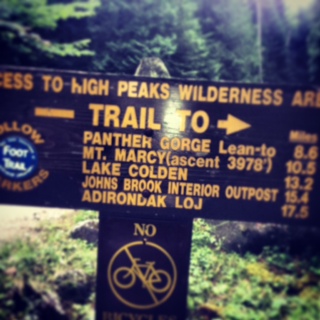
 #2 Panthers Gorge, Adirondacks, NY: Using this area as a base camp to tag Haystack (4960’), Marcy (5344’)and Skylight (4924’) is ideal and the bonus of the gorge to swim in on a hot summer’s day. Following the well-marked, Elk Lake Marcy Trail for 9 miles to the Panther Gorge Lean to is a fairly easy but muddy hike. I usually spend day one hiking into camp and spend the next day tagging the high peaks. My usual route in good weather is up the climb up Haystack (4960’), a very steep, rock scrambling experience. The description from the guide book describes the climb up Haystack as “one of the steepest climbs in the mountains up the south side of the peak. It is unremittingly steep with numerous small ledges posing danger of a serious fall. The trail is quite eroded in spots and offers no respite to timberline”. It may be tough but the climb up Haystack is work the incredible views of the Adirondack range and a great place to take a few minutes to rest up for the next climb up Mount Marcy (5344’).The trail along the ridge from Haystack goes over Little Haystack and down a few hundred feet to start the ascent up Mt. Marcy via the Hovenberg Trail following cairns along the slabs of open rock to the summit. In good weather the summit of Marcy is a wonderful place to linger and soak in the views of the Great Range. With the hardest part of the day hike done the descent down Marcy goes quickly and soon returns to below tree line and before long reaching outlet of Lake Tear of the Clouds, the highest pond source of the Hudson River. Just after this is the Four Corners Junction which joins the red trail to Mt. Skylight (4926’) and a quick 1 mile round trip to tag yet another high peak and back to Marcy-Elk Lake Trail back to the campsite. This 1.2 mile rocky trail is quite eroded in spots and requires careful attention to footing, especially after hard rain, becoming more like a river. Finally reaching the Panther Gorge crossing and back to a well-deserved evening at the campsite before hiking the 9 miles back to my car at the Elk Lake Parking area in the morning. 

#1 Devils Path, Catskills, NY: This trip follows the Devil’s Path over what Backpacker Magazine says is “the most challenging trail in the Northeast” with a reported 14,000’ of elevation change over 23.1 miles. My preferred route for this hike is from East to West over 3 days/2 nights. Beginning on Prediger Road near the Town of Hunter the red blazes don’t waste any time following the steep trail up Sherman’s Lookout, known as the chin of the Indian, and the summit of Indian Head Mountain (3573’). Like many parts of the Devil’s Path the trail up Indian Head is extremely steep something I really never get used to but come to expect on this particular trail. The trail then descends into Jimmy Dolan’s Notch, the highest col on the trail at 3,200 ft, before the rock scramble up Twin Mountain (3640’). The view off the southern summit of Twin has incredible views of Slide Mountain and all the other major peaks in the Catskill Range. After scrambling over the next high peak, Sugarloaf Mountain (3800’) the trail drops steeply down a rock chute nick named “Suicide Mountain”; this is considered one of the most challenging descents on the entire Devil’s Path. From here the end of day one is in sight and I get on the Mink Hollow Trail where a lean to, reliable water source and tent sites provide a nice place to rest up for the challenging day ahead. Day two begins with a…you guessed it! A steep and rocky climb up Plateau Mountain (3840’), a viewless summit but a nice flat walk through a boreal forest. Further along the trail, Danny’s Lookout gives way to views of Hunter, Southwest Hunter and West Kill Mountain. From here the trail goes descends to Route 214, the trails only road crossing, which is about the half-way point of the Devil’s Path. There is an area with picnic tables, a water spigot and a great place to stop for lunch before the next steep climb up past the large stone outcrops known as the Devils Portal. The forested trail on the western section of the Devil’s Path goes by the Devil’s Acre lean to where I usually pick up more water before pressing on to my next camp site, Diamond Notch Falls. There is a nice lean to up off the blue-blazed Diamond Notch Trail but further along the path is a lovely secluded tent site with good tree cover. Water? No problem! A nice late afternoon stroll down to the roaring Diamond Notch Falls provides much need drinking water and a great swimming hole. Day three gets easier after the long slog of a climb up West Kill Mountain (3880’), the sixth highest peak in the Catskills and the only high peak in this section of the Devil’s Path. The summit of West Kill has no views but just before the official summit is Buck Ridge Lookout with views of Hunter and Southwest Hunter, Slide and Peekamoose Mountains. The Devil’s Path descends gradually over the next two miles before the last rocky chute up St. Anne’s Peak. Only a short climb but by this point in the trip my legs are revolting against me! Luckily soon after, the trail switchbacks down through a nice forested trail and to the spotted car on Spruceton Road where I usually say to myself “I think it’s the last time I’m doing this trail” only to return the next summer to what has become my favorite backpacking trip in my New York. 
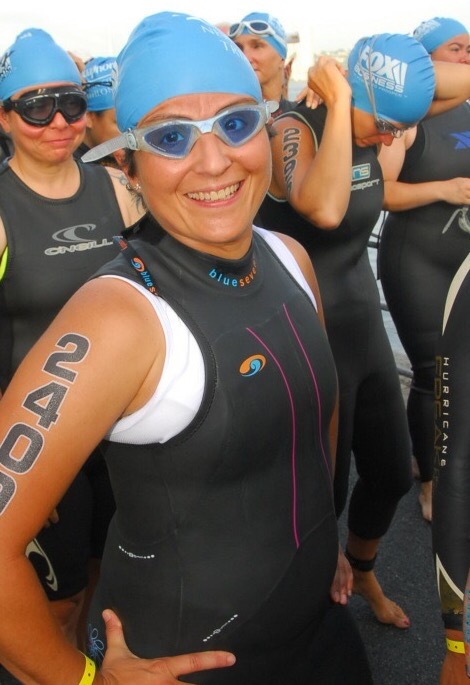
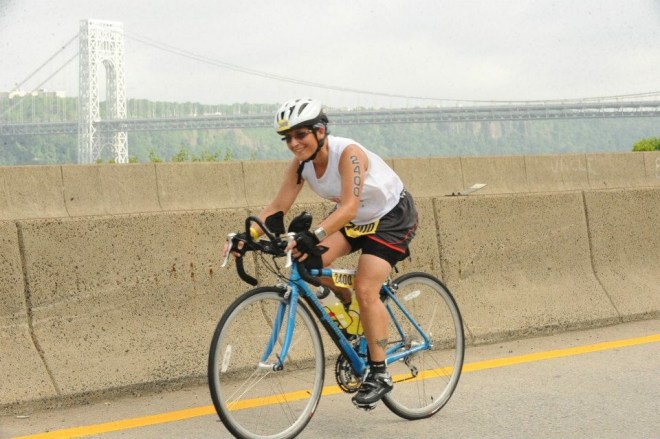
Hilltackler does triathlons ?!?!

A little known fact about yours truly, for the past 3 years I have been doing a few triathlons a year.

 waiting in the corale to jump into the Hidson River


 The sport of triathlon has been growing in recent years and it’s no doubt why. Typically as we age it gets more difficult to maintain a healthy body weight, avoid injuries and stay motivated with fewer outward results, especially for women. 

While there are triathlons in various distances ranging from sprint (easiest) to the ironman (hardest).  I have only participated in Sprint and Olympic distances but the sequence is the same for all: swim, bike and run. Yes, Consecutively! 


I’m not super competitive in these races, more like a finishers race for me, however, I have really come to love the multisport training. Typically in the past I have used running or biking  to stay in shape for the hiking season. I usually would do a few running races a year for the sole purpose of motivation to train. I’ve always been in decent shape but never terrific. And after a while boredom kicks in and I lose my ambition to run consistently. My solution to this – traithlons! 


I now spend many hours working out each week but I’m rarely bored. Varying my workout schedule with swimming, running and biking has made it fun and has greatly improved my fitness especially when It comes to hiking and backpacking.  I find I’m able to walk more miles on the trails and I am far less fatigued. My recovery time from very tough backpacking trips has decreased, less aches and pains and more energy overall. 


Pulling a pulk in the Adirondacks…the last big winter trip of 2015

This past weekend I led a group of Appalachian Mountain Club (AMC) backpackers into the Marcy Dam area 3 day/2 night winter base camp high peaks adventure.

Usually I carry my large winter backpack, Gregory Diva 85 but this weekend I traded that in for a pulk…yes a pulk! Which is pretty much a sled attached to poles that clips onto a harness worn on your waist. 


 A trail buddy of mine, “Nails” had been talking this whole pulling a pulk thing up for sometime and when we were discussing my upcoming Daks trip, I decided to give it a try. 

Why this trip?

A few reasons: First, this trip is a basecamp, meaning that we will hike in to a designated campsite and go hiking from there each day, hopefully tagging some high peaks. Secondly, the trail leading to our base camp is approximately 2.5 miles of fairly wide level trail and lastly…it’s much more comfortable to pull a pulk with 30-35lbs of winter gear than it is to carry it on your back. 


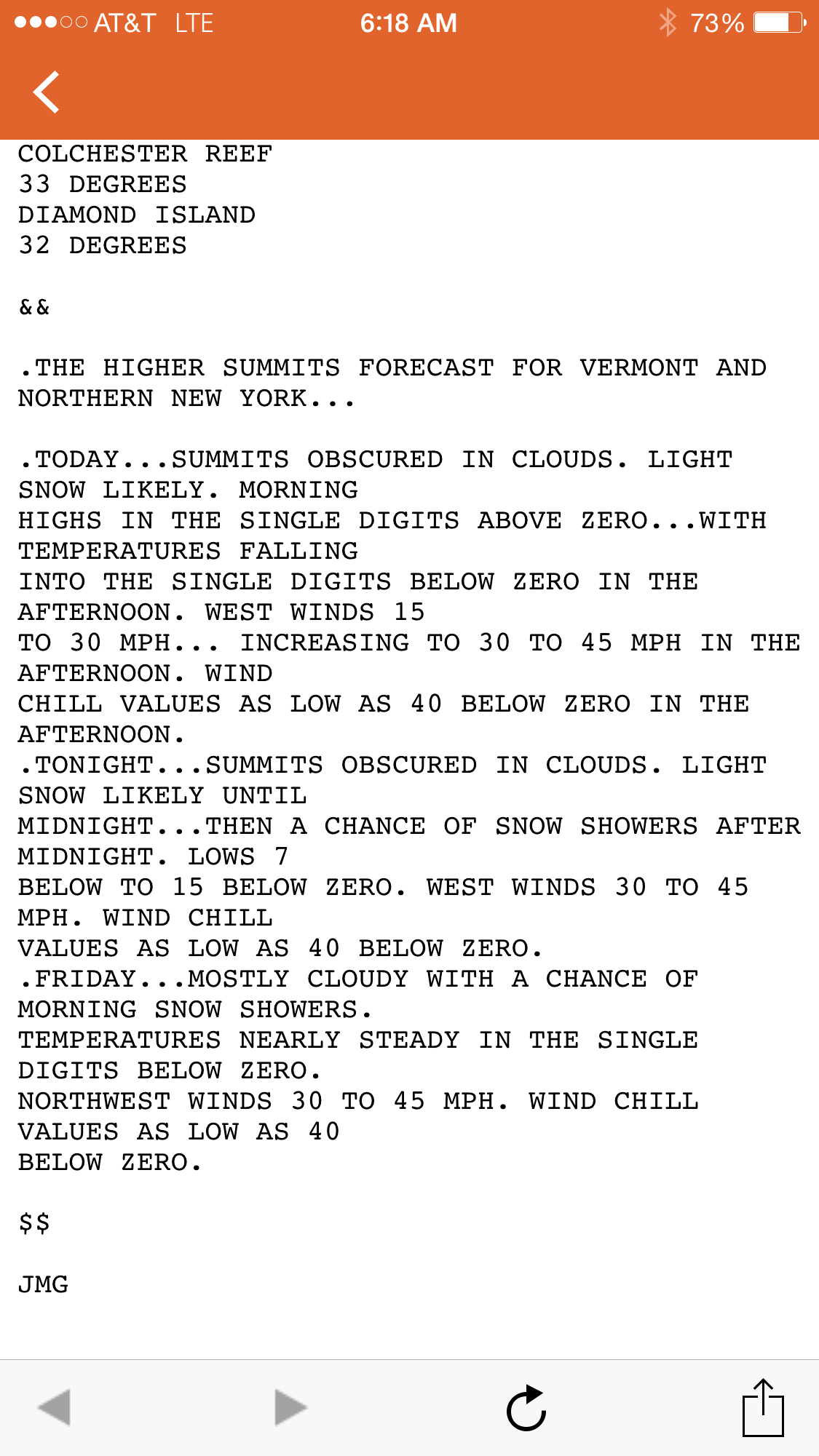
the high peaks weather forecast for friday


 At the start of our trip I was a little concerned. The temperature was minus 12 and the wind was probably 20-30 mph. It was COLD! I had some thoughts of calling the trip as I was driving to meet the rest of the group on Friday morning. I had been watching the higher summit forecast for the area like a hawk all week. We would be down in the low lands but the temperature was still projected to be as low as 40 degrees below zero. Game time decisions would have to be made about what peaks to hike but my intended plan was to hike Phelps (4161′)the first day, Colden (4715′)the second day and tag Tabletop (4427′) on a quick day hike on the third day.
I attached my sled to my waist of my osprey day pack and easily glided my sled the 2.5 miles to the Marcy dam area where we set our base camp.


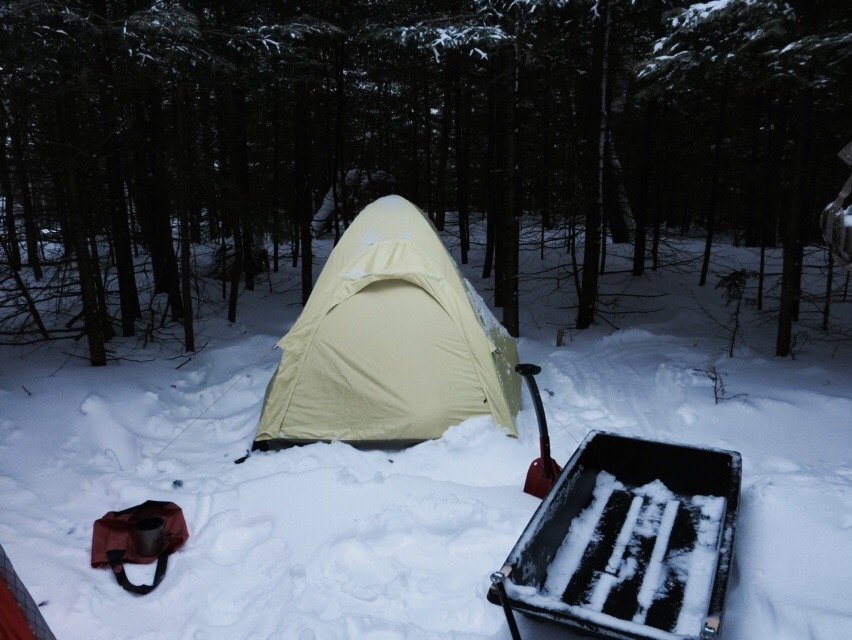
home sweet home. no heat but plenty of fresh air!


 The wind died down by the time our group set up camp and geared up to climb Phelps. The trail to Phelps was nicely broken out and snowshoeing was a pleasure. We hit the turn off to head the mile up to the summit and up, up and away we went. The view was spectacular and we hung out there and soaked it in for a while before heading back to camp. 


 Our group of seven hung out in the lean to and melted snow for water for a couple of hours. I was in my tent by 7pm and snoozing shortly after…winter is my time to catch up on sleep. I never sleep for more than 6-8 hours at home so getting 12 hours in my sleeping bag is just fine with me. 

 The next morning the weather had turned very very windy. Even down at our lower elevation the wind was blowing 30 mph. I really wanted to go with the plan to hike the 8 plus miles round trip to Mt. Colden but the climb to the top of Colden is exposed and steep  and would not be easy in very high winds and blowing snow. We discussed it as a group and decided that hiking to Tabletop would be a better call but three of the guys decided it was even too cold and windy to do that so they decided to hike up Mount Joe. 


The other four of us set off to Tabletop around 9am. Along the way lots of hikers and skiers were on the trails too. Quite a few hikers were headed up to Marcy which was interesting to me because if the wind was 30 mph at 2000 feet I can’t imagine what it’s going to be like on top of the highest peak in the range! Then I began to question my decision to call off going to Colden. Did I wimp out? Was I being too cautious? I’m not one to be scared by weather but I was not feeling anywhere near 100% – I had been plagued with a bad head cold all week and while I felt well enough to hike I just didn’t think pushing myself physically would be smart. If the hike to Colden went perfectly I would probably be fine but if something went wrong, if one of our hikers suffered an injury or the weather conditions deteriorated any further I might be a hinderence. As a trip leader that’s never a good scenario – so to Tabletop we hiked. 


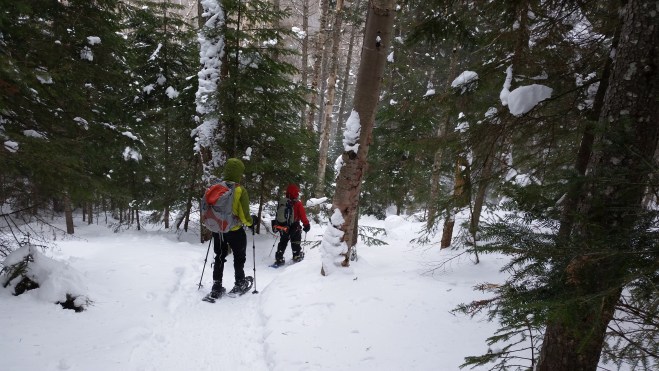
hiking up the trail to tabletop


The route up tabletop is very protected from the beastly wind and we had a lovely climb up to the top. Just enough of an opening at the summit to see Mt. Marcy across the way and take in views without being blown over. 


lookking at Mt. Marcy from summit of Tabletop Mtn


We headed back to camp early and I retreated to my tent to get some rest, I was definitely feeling worse. After an hour or so I psyched myself up to get back out of the tent and start melting snow for some much needed water. The wind was now blowing snow and gusting up to 35 mph. Usually, melting snow in the lean to protects me from the weather but the wind was blowing the snow right in the front of lean to. Soon I melted enough snow to rehydrate my dinner and made a hot beverage to take back to my tent. I was really glad to get back in my sleeping bag. I was even more grateful that I had downloaded one of my favorite t.v shows, Suits, to my smartphone to keep myself entertained for a while before I could take my dose of NyQuil and get some much needed sleep. 


larry, all smiles …the wind is gone!


The next morning I awoke to the sound of…NO WIND! I stuck my head out of my tent at 7am and the sky was blue and the sun shining bright! A perfect day to hike but everyone had had enough and wanted to hike out and go home. So I packed up my stuff, put it in the pulk and pulled it home! 

My thoughts on pulling a pulk…it is the way to go! I didn’t even notice I was pulling any weight until the up hills and even the  it was much easier than having the weight on my back. 

One of the big benefits to the pulk is not having to be so mindful of the weight of each item. This trip I was able to bring my alite camp chair, an extra down jacket and my BD shovel. My total weight was probably almost 40lbs with food, fuel and water. My winter backpack weight is usually 30-32 lbs and if feels much heavier! While pulling a pulk isn’t practical in every winter backpacking scenario I think there are a fair amount of winter routes that I could use this on in the future. 

When u got home, I called my buddy “Nails” and told him all about my love for the pulk. Needless to say he is making me one of my very own for next winter! So there will be more pulk pulling adventures next winter but for now I look forward to more spring like weather and getting back to my light weight backpacking kit! 


Cold Weather Backpacking…sometimes it is about survival.

IMG_2691

This morning I read about a woman that unfortunately lost her life while hiking in the White Mountains. It’s a very tragic situation but also a real risk when winter hiking, especially solo.

This story reminded me of a trip report I had been working on for my blog. I never actually posted it because it was well…just another winter trip report and the trip didn’t go off as planned. The working title was “winter backpacking: plan, revise, repeat…lessons learned about surviving the COLD”. The unfinished post had been in my drafts queue waiting to be published. This morning after I read the news article about this hiker losing her life, I reflected on my recent trip to the Catskills and whether or not I should have “called the trip” because of terrible weather.

This overnight backpacking trip took place in the Catskills, New York the second to last week of January. I’ve done this particular trip every winter for the past 4 years and really like the route. The first day is 1500 ft of elevation over 3 miles or so up an old truck road that tops out at the Hunter Mountain Fire Tower. From there it’s another 4-5 miles to our campsite near the lovely Diamond Notch Falls area. The second day Is the real challenge heading up the Devils Path over Westkill Mountain (3,880′) down the other side and back to our cars. A total of 16.7 miles over 2 days with a full winter pack. However, this weekend the mountains had other plans.

IMG_2687

The morning temperature was zero degrees and the winds were forecasted to be up to 30-40mph. Our group was small, made up of 4 experienced four season backpackers. Heading up the jeep road towards the fire tower was hard work but doable since snowmobiles had packed down the trail. Until we reached about 3500 ft then all that lay in front of us was a foot or more of fresh powdery snow, lovely to look but not so easy to hike through with a heavy pack and snowshoes strapped to your boots. We switched to a rolling lead, 25 paces then fall out and let the next in line break trail. The rotation helps even out the workload and catch some rest as we roll the leader. With only four people this was still quite tough.

IMG_2689
At 11:30 am we reached the Hunter Mountain fire tower and took a minute to regroup. The wind was whipping and we needed to keep moving in order to stay warm. At this time one guy in our group mentioned that his feet were getting really cold. He was also getting fatigued from carrying his pack and was contemplating turning back.

IMG_1551
Knowing the route and consulting the map, I knew that further along the trail was fairly flat and there was a lean to in 2 more miles. We discussed the option of getting to the lean to, taking care of his feet and making a decision from there how we would proceed. We all agreed. We pushed on and broke trail for another two miles to the Devils acre lean to. Excited to have reached the 3 sided structure but slightly disappointed to see the floor of it with 6-8 inches of snow drifts and an umbrella, of all things!

We worked quickly to get our friend onto an insulated mat and into his -25 degree sleeping bag. Shortly later we started pumping him with snacks and hot beverages. Before long his feet began to get toasty warm. Thankfully, at no point did this guy ever exhibit signs of hypothermia. His spirits were good and his feet warm but he didn’t think he could hike any further so it was then we all decided the best thing was to stay put, set up camp and hike back out the way we came to our cars.

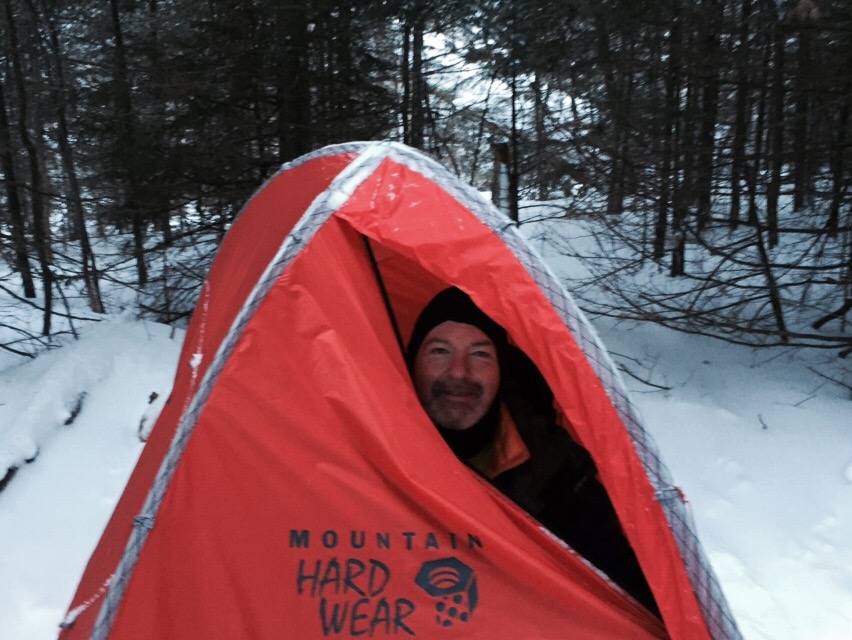
Setting up camp is usually a no brainer…whip out the tent and wholla! Well, in 30-40 mph winds it ain’t so easy. I have a 4 season free standing tent which I couldn’t get to stay put! Every time I got it on the ground the wind would just HOWL and flatten it out. Trying to put stakes in the ground to hold it down proved useless, the snow was a fine powder with no sticking power and the ground frozen solid. Finally, I just tied a guy line to a small tree and began hunting for large branches to weigh down the other guy lines. An hour later I finally had the tent up and pitched. It was now 2pm!

As we all sat – for hours – in the lean to we melted snow for water, ate our food, talked gear (of course) and all agreed that these conditions were really challenging. The wind was absolutely blasting, which made the temperatures plummet into the negatives, Making even the simplest tasks seem monumentally difficult.

We eventually all got our tents anchored down but the wind continued to whip it up! At one point I was in my sleeping bag and the side of my tent was touching my face because the wind was blowing with such force. We still all managed to get a great nights sleep despite the noise and awoke to a very cold but windless morning! We packed up and started 5 or so miles back to where we started. Thankfully the wind had not blown in the trail we broke out the previous day.
We made it to our cars within a few short hours, with smiles on our faces, happy that we were able to spend the night in the woods, even if it wasn’t the trip we had planned on.

As I drove home I reflected on this trip and for me it served as a reminder of how flexible I need to stay during winter hikes and overnight trips. Even though I plan a fairly detailed itinerary, bring a map and all my gear I think the most important thing I can do is to remain flexible…each trip unfolds differently.

Adirondack’s Panther Gorge Trip Report…a river runs through it!

big bear warning sign

In early August I led a backpacking trip for the NY/NJ Backpacking Chapter of the Appalachian Mountain Club (AMC) to the Adirondacks.  The plan for this trip was to leave our cars at the Elk Lake Parking area and hike 9 miles on the Elk Lake Marcy Trail. Set up base camp and on day 2 hike up Haystack (4960′), Little Haystack , Mt Marcy (5344′) and Skylight (4924′) and on day 3 hike the 9 miles back to our cars.  This is a very enjoyable trip. Other popular routes to Mount Marcy such as the VanHovenberg Trail can get crowded, especially in summer, going this route gives our group some solitude.

panther gorge trail head

The hike up to the Panther Gorge Lean-to is fairly straight forward and the easiest part of the whole weekend. The nine mile trek on the Elk Lake-Marcy Trail is well marked, fairly easy walking with some boggy areas and plenty of creek crossings. The water levels of the small streams and boggy areas weren’t too bad. The Adirondack trails are known for their MUD and as always I got knee deep! Never fails. As I was merrily walking along the trail I took a step and my right leg sunk into the MUD up to my knee. Thankfully, Stretch, my co-leader was there to witness this comedic event and after we both stopped laughing I took my pack off, broke free of the suction hungry MUD and pulled my foot out. And it always makes for a good picture!

Adirondack MUD

Adirondack MUD

Our group arrived to the Panther Gorge, around 3pm,  area hoping to set up and enjoy the solitude…well, maybe not! We arrived to tent city! The area was packed with tents and the lean to was filled to capacity.  We set up our tents and, hoped to get settled in and go down to the lovely gorge and relax before dinner.  And then the rains came! When you thought it was raining hard, it started to rain even harder, you could barely hear yourself talk over the sound of the loud gushing water flowing in Panther Gorge below us.

Stretch in the rain with her spork

Stretch in the rain with her spork

We donned our rain gear and began to prepare dinner.  On this and my other summer trips I use Esbit tabs with my Caldera Cone set up. It’s incredibly light and efficient at boiling 2 cups of water in less than 12 minutes. Well, except when it’s pouring and as you’re lighting your Esbit tab it gets too wet to catch fire. That’s a first for me, usually I just hit the tab with a storm proof and BAM!  But not in this downpour! So I took to the vestibule of my tent and tried again with a dry Esbit tab and a wallah! Stretch took to waiting outside my tent for me to boil her water too so she could eventually retreat to her tent and get dry once and for all.

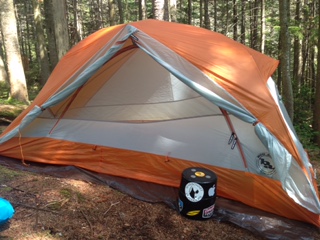
Big Agnes UL1 Copper Spur

Big Agnes UL1 Copper Spur

Sunday morning we got up to bright sunny skies but I knew it was going to be short lived.  I  had paid special attention to the weather forecast before this trip because we would be hiking above tree line quite a bit. Bagging some high peaks is always the goal but safety is first and foremost. Prior to the trip I had  put out some inquiries, on the ADK high peaks forum, for good alternate below tree line hikes if the weather turned for the worst. But according to all the forecasts of the high peaks, there was a 30% chance of showers and thunderstorms were to hold off until after 2 or 3pm. So I made the decision to go ahead with the original itinerary.

Route to Haystack, Little Haystack and Skylight Mtns

Route to Haystack, Little Haystack and Skylight Mtns

We got a fairly early start and headed up the trail to Haystack Mountain. It is described in the guidebook as  “one of the steepest climbs in the mountains up the south side of the peak. It is unremittingly steep with numerous small ledges posing danger of a serious fall.  The trail is quite eroded in spots and offers no respite to timberline.” It is also recommended that backpackers not to attempt this route with full packs due to the amount of rock scrambling. But it makes a perfect loop to grab some of the highest peaks in New York State and get back to camp in a day hike, which is very sweet!

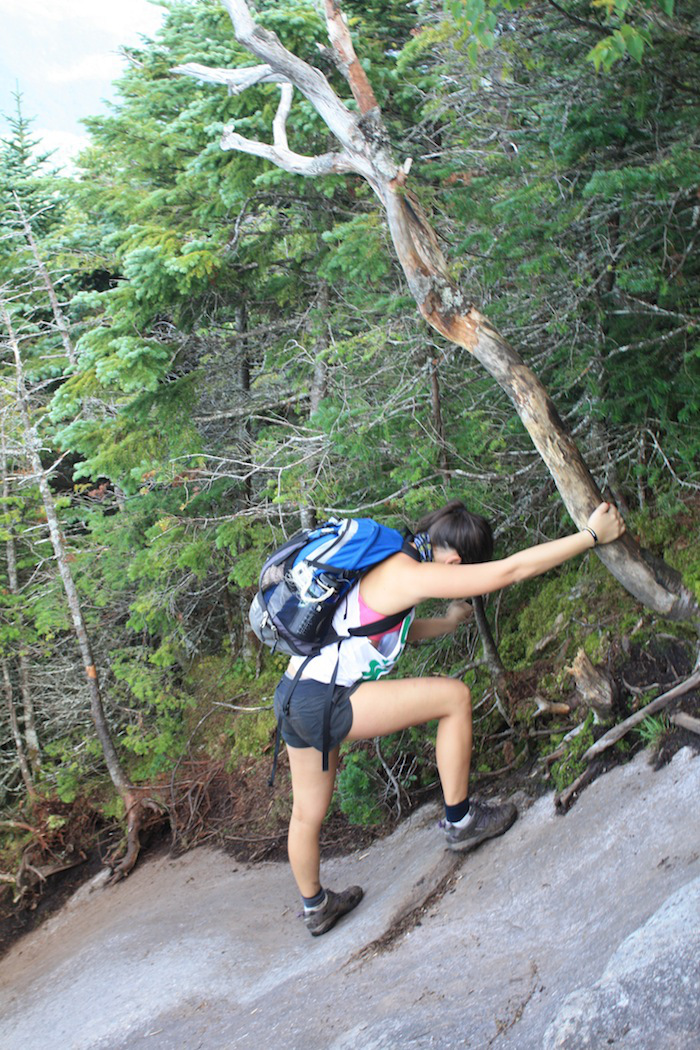
This is how you get up Haystack!

This is how you get up Haystack!

The 2.2 mile climb up Haystack was slower than usual because the torrential rain from the previous nights storm. The large slabs of rock were slick and like a water fall in some places. This part of the day was definitely physically as well as mentally challenging.  But we all made it in one piece and were treated to lovely views on top of Haystack.

haystack top of mtn

Hilltackler on Haystack

Hilltackler on Haystack

After taking in the views and taking a well deserved snack break at the top of Haystack we shouldered our packs and continued over Little Haystack. It was about 11 am and the clouds were rolling quickly across the sky. One minute you would look across the ridge and see Mt Marcy very clearly and a few minutes later she would be covered in large ominous clouds. It began to drizzle as we passed over Little Haystack and descended the State Range Trail before heading back up the Phelps Trail to Mt Marcy. The Phelps Trail climbs steeply for .7 miles and intersects with the Van Hovenberg Trail. We are now entering into the Alpine zone.

Entering the Alpine Zone

Entering the Alpine Zone

From here the trail is all open rock to the summit but not so steep, thankfully because the wind and rain really started blowing so we carefully followed the trail blazes painted on the slabs of rock and cairns to the top.  The Summit Steward greeted us with a big smile in her blue poncho. She was as happy as clam to be up on top of Mt. Marcy even in the rain and wind. She said the Summit Stewards are out most days unless there is lightening. We thanked her for her service and pushed on over the summit as quickly as possible as thunder clapped in the distance.

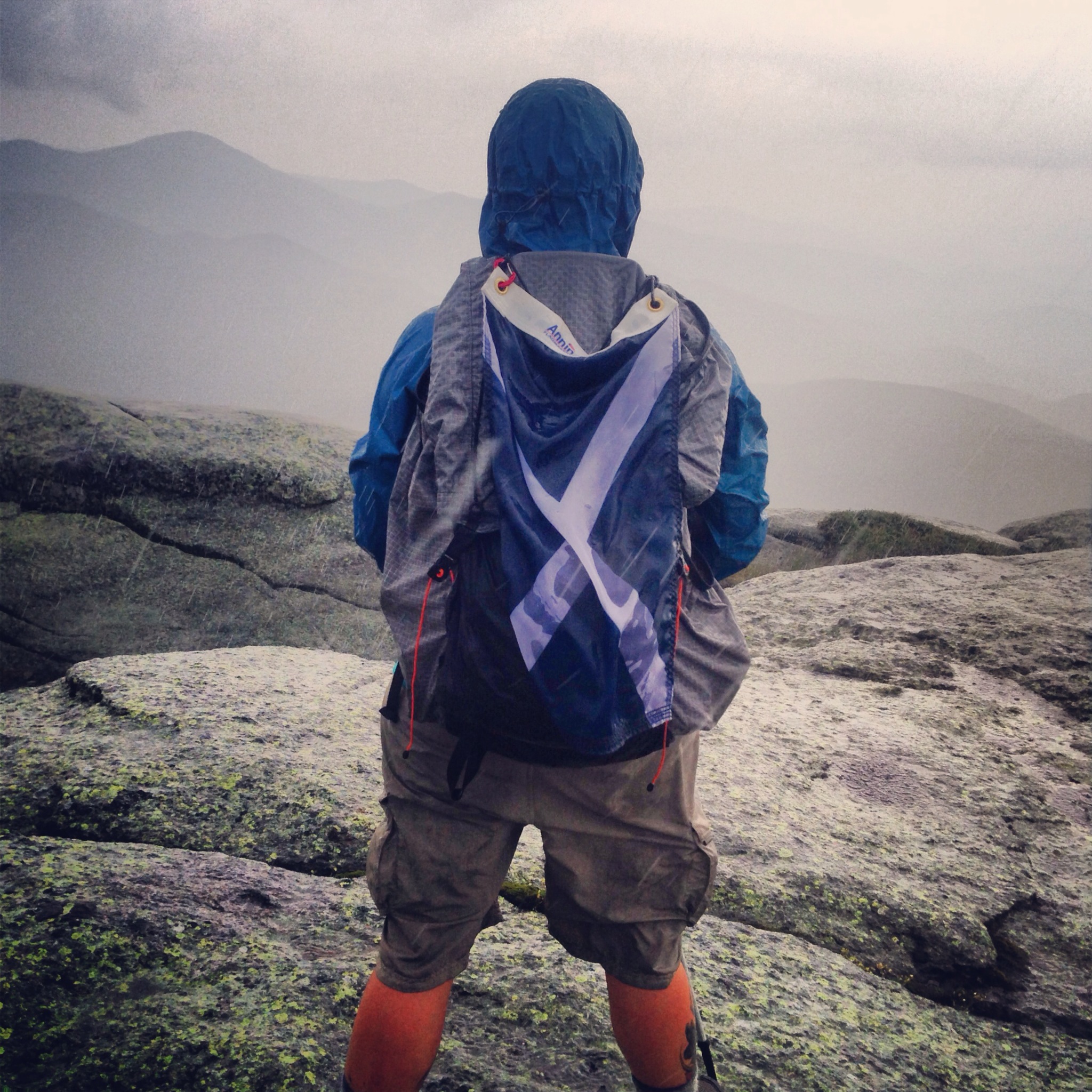
The view from Marcy in the rain

The view from Marcy in the rain

The trail leading off the summit of Mt. Marcy is not overly steep but it is exposed rock and it was becoming quite slick. I took to butt sliding in places. I think my nerves were shot as it started to thunder along with the blowing rain and looking over the side well it just goes – down! Finally the trail started to give me some traction as it descended below tree line but then it was just like a river. All the water was just rushing down the trail. I was certainly glad to be wearing trail runners because the water just comes out the mesh so you’re wet but at least you’re not sloshing around in it.

Finally arriving at the Four Corners, it was decision time to – bag Mt. Skylight or just continue on the 1.2 miles back to camp. We all agreed the weather was getting worse and headed down the Elk Lake -Marcy trail or should I say RIVER – the whole trail was over taken by water! It was ankle deep and sometimes more and It took careful footing. Even when  the trail is dry it is  quite eroded and rooty, add in 6-8 inches of flowing water and you can easily loose your footing and get hurt. This is one of the reasons why I always use hiking poles. They provide extra support and balance in tricky footing. Never leave home without’em!

Finally back at the gorge by 3:30pm our last water crossing was Panther Gorge. It is a tricky rock hop to get across the gorge and I was DONE concentrating on my foot placement so I just unbuckled my pack, in case I got swept away by the quick moving water, and walked through the knee deep gorge to get the other side. As we each made it across the gorge we would turn around and hoot and holler the next person as they made their way across. We had just completed a tough 7 mile hike with quite a bit of elevation gain and loss in very difficult conditions and I think we all felt like we really accomplished something! Conditions like this either rip a group apart or bring them closer together and I think it brought our group closer.

Exhausted but fulfilled I made my way back to my tent and took off my wet clothes and got ready to have a well deserved hot beverage and snack. The crowds had cleared out and our group had the campsite and shelter all to ourselves. We all sat around as darkness came and recounted some of the days adventure and talked gear, of course!

It rained most of that night and into the morning. We all got up at 6am determined to leave this rain forest by 8am. I made coffee and packed up my dripping wet gear, put on my wet clothes and shoes ready to hit the trail. I’ll say at this point I’m glad I kept my long john bottoms on. Because we literally walked in water for most of the 9 miles back to the cars at the trailhead. Thankfully there were a couple nicely built foot bridges to get across some of the larger rivers. We all stuck together and just marched on through the knee deep water and laughed ALOT! I was just comical walking on a trail made of water. The trail became dry and flat as we got with in a mile or two of the cars however the bugs were out in full force and head nets became necessary gear to avoid being chewed up by deer flies.

As we stepped out of the woods and got to our cars it began to rain again. Seemed like an appropriate ending for this trip!

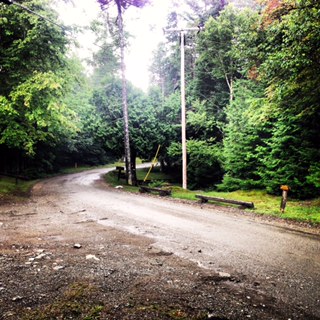
Road leading to Elk Lake Parking area

Road leading to Elk Lake Parking area

Chipping Away at the Miles on the AT in Connecticut…

Drip and Hilltackler's weekend adventure

Drip and Hilltackler’s weekend adventure

This past weekend my friend Trudy “drip” and I planned to do a section hike of the AT starting from Salisbury Route 41 to Dawn Hill Road, approximately 24 miles over two and a half days. This wouldn’t be a conventional start for me, I usually start trips in the early morning or at least sometime in morning but I really wanted to knock out these miles to move closer to finishing off CT. Drip had to work until early Friday afternoon and If we met by three and did the car shuttle we would be at the start point in Salisbury by 4-4:30, giving us plenty of daylight to take the fairly easy walk to the Limestone Lean-to.  That was the plan but Drip was detoured by severe traffic and was forced off the highway to the country roads with the rest of the travelers.  In the end we met up and parked Drips’ car at the endpoint around 5:30pm. We then hopped in my car and drove to Salisbury excited and ready to start our adventure! The weather was forecasted to be beautiful and almost summer like for our section hike. Stoked! As we set off on the AT heading southbound we knew that we would only have about an hour or so of light left and we would have to hike part of the way in the dark by the light of our headlamps.

IMG_2074

 
Before this weekend’s trip there had been a lot of talk of bears. A man in New Jersey was tragically killed by a black bear while out hiking with his friends the previous weekend. As experienced hikers we understand that this incident is very infrequent but still can play with your mind, especially in the dark! At least for this hiker. Put that together with all the talk of bears on the evening news, social media, and the hiking groups and forums I participate in online – it was bear mania! Everybody had a story! With all this in mind and the fact that Drip and I would be hiking in the dark we talked loud and every so often would clap our hands. We had a lot of fun following the trail by the light of our headlamps.

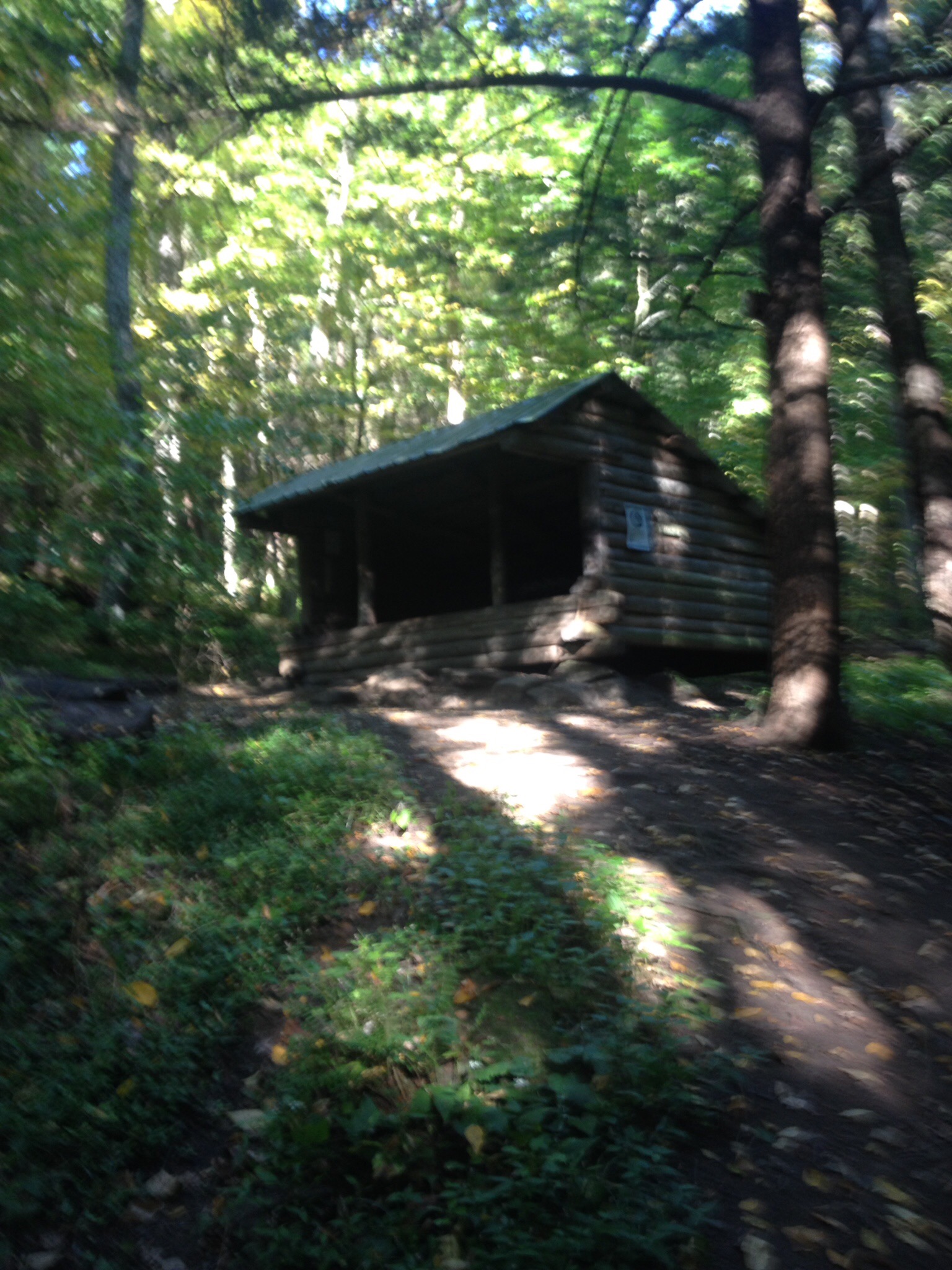
Limestone Shelter in the light of day!

Limestone Shelter in the light of day!

The section of trail leading to the Limestone shelter area is fairly flat and we made the blue blazed side trail by 8pm. The footing gets a little steeper and rockier as we descended to the shelter area. It was then we discovered that the keys to our car at the end were in the glove box of my car back in Salisbury. Somehow this didn’t seem to bother either me or Drip. That’s the thing about backpacking…it’s best to stay flexible, plans often have to change based on circumstances such as injury, weather or mistakes.  As Drip and I set up our hammocks we both agreed that the best plan was to hike back to the car and move it further along on  Route 7 and then  continue the hike to the Sharon Mountain campsite. This cut out five miles or so but that would keep us on track for getting to our end point on Sunday.

So we hiked back to my car on Route 41, often noting how different things look in the day time. We met a south bound thru hiker “The Clark” and his dog “Pistol Pete”. They were quite the duo. The Clarke had already section hiked the AT over 14 years and decided this year to thru hike the entire trail. It was nice to run into a thru hiker and chat it up for a couple minutes. As Drip and I continued on we took in the views we missed, due to darkness,  on the way up the night before so we stopped and soaked in the views on the way back down.

Rands View


We arrived at the car – secured the car keys – and headed to the parking area along route 7 and jumped back on the trail and headed towards Sharon Mountain campsite. We only had a couple miles to go so we took our time and enjoyed the trail. This section of trail doesn’t have too many views but the best of the day was Hang Gliders View where we took a long snack break.

View of the Day! Hang Glider Veiw

View of the Day! Hang Glider Veiw

Drip and I got to the Sharon Mountain campsite around 4pm. It’s a nice site with plenty of tenting areas and usually a good water source. I knew going into this trip that water sources along the way would be scarce. I’m a regular reader and poster on Whiteblaze a hiking forum dedicated to the AT and other long distance trails. During the week I had inquired about the section Drip and I would be on and most people who had been through there lately had mentioned the lack of water. Luckily we had a nice sized puddle to pump out of, after the frogs hopped away. I carry a sawyer squeeze and the thought of pre-filtering while I was so thirsty was unappealing but Drip to the rescue with her Katydin hiker pro pump! Clean water for all!

The Clarke & Pistol Pete

The Clarke & Pistol Pete

As we settled into our home for the night, The Clark and Pistol Pete came down the trail. Unbeknownst to us this was their destination for the night too.  The Clarke had started south bound from Maine a couple months prior. He was enjoying the easier terrain of Connecticut and getting in more miles every day.  Going south bound on the AT is a different experience than doing the usual northbound hike, more soliltude but The Clarke seemed to enjoy that aspect of his journey. We sat around camp as darkness came and chatted about the trail, life and our names in the real world. Pistol Pete napped in the cool dirt. Before turning in for the night, we offered The Clarke to share our bear rope, so me, Drip and The Clarke walked down the trail with Pistol Pete leading the way to hang our food. We all went back to camp and said our good nights. I climbed in my hammock and drifted to sleep quickly. Tomorrow would be our longest day of the weekend, 10 miles.

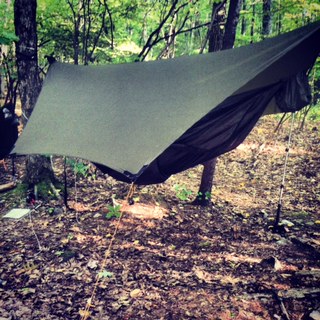
Warbonnet Blackbird Hammock

Warbonnet Blackbird Hammock

We got an early start on Sunday, our last day, on the trail and began hiking by 8:30 a.m. Drip and I planned to hike a steady pace for the six miles to the Caesar Brook Campsite where we would have lunch and fill up on water before banging out the last four miles back to the car. I planned to have Friday night’s dinner as my lunch. Not my usual practice but I was hungry and didn’t think another protein bar was going to cut it so I fired up the Jetboil. A lunch of sustenance was needed!

While the AT in Connecticut isn’t very steep, it is bumpy! The trail loses a couple hundred feet of elevation every time you hit a road only to have to climb back up…all day long.

Drip in Split Rock

Drip in Split Rock

Drip and I packed up and headed down the trail for the last four miles back to the car talking about our post hike food. We reached the car around 4 p.m.  After picking up my car we stopped in Cornwall and grabbed a great burger before we parted ways and of course talked about our next section hike of the AT!